
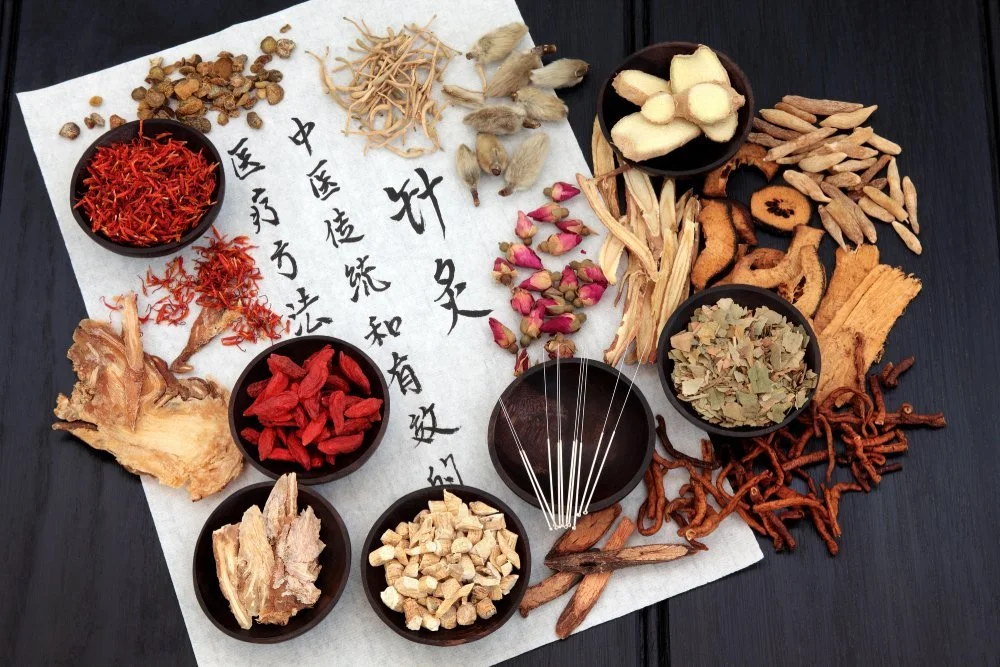
Most people booking a first appointment are picturing one thing: thin needles, a quiet room, an hour on the table. That is part of it. But Chinese medicine and acupuncture in Oakland is a complete system of medicine, and the needles are one method inside it. What I use in a given session depends on what I find during your intake, not on what the appointment is called on the schedule.
That distinction matters more than it sounds like it should, because it changes what you can bring to a visit and what kind of support you can reasonably ask for.
Acupuncture Is One Method, Not the Whole Medicine
Traditional Chinese Medicine covers several therapies developed to work together: acupuncture, herbal medicine, nutrition and diet therapy, tui na or Chinese bodywork, and movement and exercise guidance. A practitioner trained in the full system is choosing among all of these, not simply deciding where to place needles. The acupuncture treatments I offer sit inside that framework rather than standing on their own.
My own path ran through nutrition first. I finished a degree in nutrition and dietetics and began practicing integrative care in 1984, later completing my masters and clinical training in Chinese medicine at the Academy of Chinese Culture and Health Sciences here in Oakland, and brought acupuncture and TCM into the practice in 2003. I am licensed as both an acupuncturist and an herbologist, which is why food and formulas come up in my treatment room about as often as needles do.
The Tools I May Reach For in a Single Visit
My practice covers acupuncture, nutrition, and herbal medicine, cupping and moxibustion. Here is roughly when each one earns its place.
Acupuncture needles. Fine, sterile, single use. For pain work this often means trigger points, motor points, and distal meridian points rather than needling only where it hurts.
Electro acupuncture. A gentle current applied through the needles, commonly used for stubborn musculoskeletal cases.
Cupping and gua sha. Both work on surface tissue and fascia rather than through needles. Useful when muscles are tight and restricted.
Moxibustion. A warming therapy applied near the skin, traditionally used where cold and depletion show up in the presentation.
Herbal formulas. Prescribed to match your pattern and adjusted as things change. They are one of the few parts of a plan that continues between appointments.
Nutrition and diet therapy. The least dramatic part of the plan, and the part that asks the most of you between visits.
Not every visit uses all of these. Most use two or three.
Why Two People With the Same Complaint Get Different Treatment
Chinese medicine does not treat the label. Two patients can arrive using the same word for their problem, insomnia, and leave with very different plans, because the presentation underneath is different. One is wired at midnight and cannot switch off. The other falls asleep easily and wakes at three. Same word, different pattern, different treatment.
That is why the intake takes as long as it does. We go through your health concerns, your full health history, and your wellness goals before anything else happens. My approach to acupuncture for pain and sports injuries also includes orthopedic testing and range of motion checks, and I welcome imaging or diagnostic reports if you have them. The more I know, the more specific the treatment can be.
What Chinese Medicine in Oakland Looks Like Over a Course of Care
A first appointment runs about 90 minutes, and what happens at a first appointment is mostly conversation: the intake, then a treatment. Follow-up visits are usually 45 to 60 minutes. Along the way I may send you home with herbal prescriptions, nutrition and diet recommendations, supplements, or self-care suggestions to carry the work between appointments.
Care is generally structured as a course rather than a single session. We reassess as we go, and what I use in week six is often not what I used in week one, because the picture changes. If part of the plan is not a good fit for you, herbs when you are already managing a long medication list, for example, we adjust rather than push.
Questions I Get Asked Before a First Visit
Do I have to take herbs if I come in for acupuncture?
No. Herbal medicine is offered, not required. If you would rather stay with needles and bodywork, say so during the intake and we will build the plan around that.
Can I keep seeing my regular doctor?
Yes, and I would encourage it. Chinese medicine is meant to work alongside conventional care. Bring your medication list, your supplements, and any recent lab or imaging results so nothing gets missed.
What should I do before my appointment?
Eat something beforehand rather than arriving on an empty stomach, wear loose clothing that can roll above the knee and elbow, and leave yourself a little time afterward. Most people feel settled and slow for an hour or so.
Booking a Visit
My practice is at 6536 Telegraph Ave, Suite A201 in Oakland, a short walk from the Ashby and Rockridge BART corridor. If you have been curious about Chinese medicine in Oakland but were unsure what it actually involves, the intake conversation is the place to start. You are welcome to ask questions before committing to a course of care, and any treatment plan should be discussed with a licensed practitioner who has taken your full history.
Call (510) 595-0700 to book your first appointment.